
☑️Introduction
Lots of theories similar to sec+
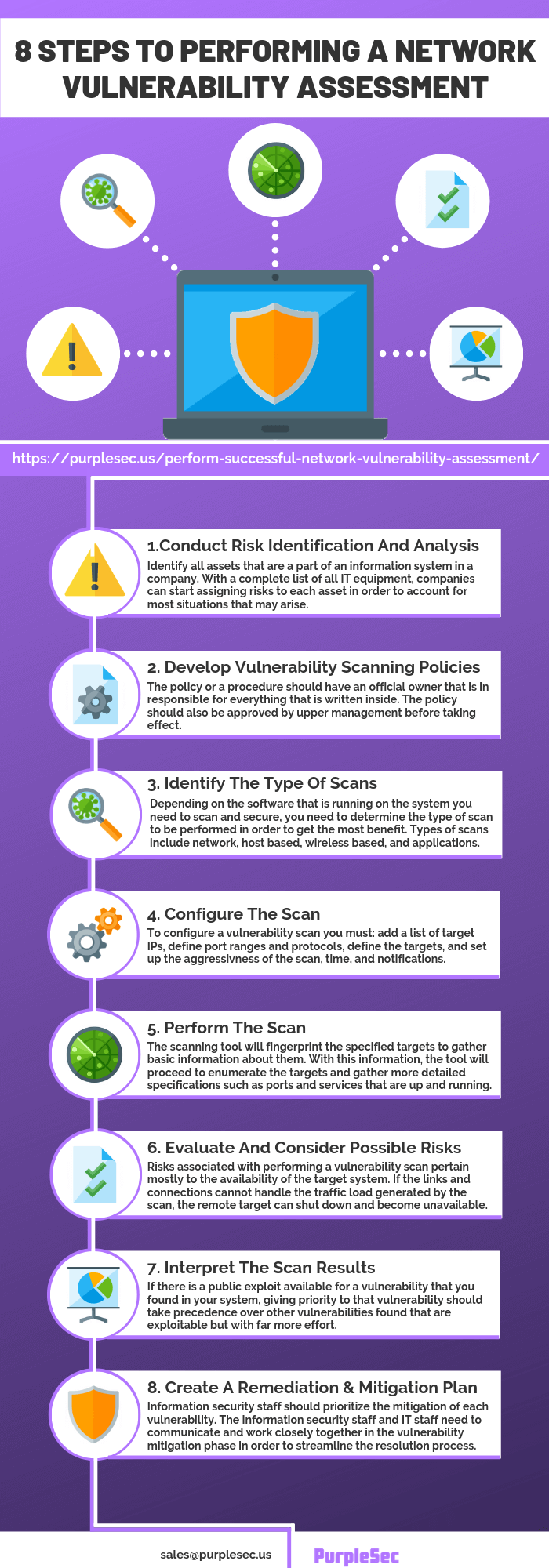
A Vulnerability Assessment aims to identify and categorize risks for security weaknesses related to assets within an environment. It is important to note that there is little to no manual exploitation during a vulnerability assessment. A vulnerability assessment also provides remediation steps to fix the issues.
Vulnerability management is vital to help organizations identify the weak points in their assets, understand the risk level, and calculate and prioritize remediation efforts.
Methodology

Terminologies
A Vulnerability is a weakness or bug in an organization's environment, including applications, networks, and infrastructure, that opens up the possibility of threats from external actors.
A Threat is a process that amplifies the potential of an adverse event, such as a threat actor exploiting a vulnerability.
An Exploit is any code or resources that can be used to take advantage of an asset's weakness.
Risk is the possibility of assets or data being harmed or destroyed by threat actors.
We can use a qualitative risk matrix to measure risk based on likelihood and impact with the table shown below.

Asset Management
When an organization of any kind, in any industry, and of any size needs to plan their cybersecurity strategy, they should start by creating an inventory of their data assets. If you want to protect something, you must first know what you are protecting! Once assets have been inventoried, then you can start the process of asset management. This is a key concept in defensive security.
Asset inventory is a critical component of vulnerability management. An organization needs to understand what assets are in its network to provide the proper protection and set up appropriate defenses. The asset inventory should include information technology, operational technology, physical, software, mobile, and development assets. Organizations can utilize asset management tools to keep track of assets. The assets should have data classifications to ensure adequate security and access controls.
We are talking about:
All data stored on premise such as SSDs and HDDs in workstations and servers.
Data stored in Cloud such as AWS, Azure, GCP.
Data stored in SaaS applications for example: Google Drive, Dropbox, Microsoft Teams, Apple iCloud, Adobe Creative Suite, Microsoft Office 365, Google Docs.
All of the applications a company needs to use to conduct their usual operation and business.
All of a company's on-premises computer networking devices. These include but aren't limited to routers, firewalls, hubs, switches, dedicated intrusion detection and prevention systems (IDS/IPS), data loss prevention (DLP) systems, and so on.
Assessment Standards
Both penetration tests and vulnerability assessments should comply with specific standards to be accredited and accepted by governments and legal authorities. Such standards help ensure that the assessment is carried out thoroughly in a generally agreed-upon manner to increase the efficiency of these assessments and reduce the likelihood of an attack on the organization.
The big compliance players in information security are PCI, HIPAA, FISMA, and ISO 27001.
Payment Card Industry Data Security Standard (PCI DSS)
The Payment Card Industry Data Security Standard (PCI DSS) is a commonly known standard in information security that implements requirements for organizations that handle credit cards.
PCI DSS requirements include internal and external scanning of assets. For example, any credit card data that is being processed or transmitted must be done in a Cardholder Data Environment (CDE). The CDE environment must be adequately segmented from normal assets. CDE environments are segmented off from an organization's regular environment to protect any cardholder data from being compromised during an attack and limit internal access to data.

Health Insurance Portability and Accountability Act (HIPAA)
HIPAA is the Health Insurance Portability and Accountability Act, which is used to protect patients' data. HIPAA does not necessarily require vulnerability scans or assessments; however, a risk assessment and vulnerability identification are required to maintain HIPAA accreditation.
Federal Information Security Management Act (FISMA)
The Federal Information Security Management Act (FISMA) is a set of standards and guidelines used to safeguard government operations and information. The act requires an organization to provide documentation and proof of a vulnerability management program to maintain information technology systems' proper availability, confidentiality, and integrity.
ISO 27001
ISO 27001 is a standard used worldwide to manage information security. ISO 27001 requires organizations to perform quarterly external and internal scans.
Penetration Testing Standards
PTES
The Penetration Testing Execution Standard (PTES) can be applied to all types of penetration tests. It outlines the phases of a penetration test and how they should be conducted. These are the sections in the PTES:
Pre-engagement Interactions
Intelligence Gathering
Threat Modeling
Vulnerability Analysis
Exploitation
Post Exploitation
Reporting
OSSTMM
OSSTMM is the Open Source Security Testing Methodology Manual, another set of guidelines pentesters can use to ensure they're doing their jobs properly. It can be used alongside other pentest standards.
OSSTMM is divided into five different channels for five different areas of pentesting:
Human Security (human beings are subject to social engineering exploits)
Physical Security
Wireless Communications (including but not limited to technologies like WiFi and Bluetooth)
Telecommunications
Data Networks
NIST
The NIST (National Institute of Standards and Technology) is well known for their NIST Cybersecurity Framework, a system for designing incident response policies and procedures. NIST also has a Penetration Testing Framework. The phases of the NIST framework include:
Planning
Discovery
Attack
Reporting
OWASP
OWASP stands for the Open Web Application Security Project. They're typically the go-to organization for defining testing standards and classifying risks to web applications.
OWASP maintains a few different standards and helpful guides for assessment various technologies:
Last updated