
ShellShock
A Common Gateway Interface (CGI) is used to help a web server render dynamic pages and create a customized response for the user making a request via a web application. CGI applications are primarily used to access other applications running on a web server. CGI is essentially middleware between web servers, external databases, and information sources. CGI scripts and programs are kept in the /CGI-bin directory on a web server and can be written in C, C++, Java, PERL, etc. CGI scripts run in the security context of the web server. They are often used for guest books, forms (such as email, feedback, registration), mailing lists, blogs, etc. These scripts are language-independent and can be written very simply to perform advanced tasks much easier than writing them using server-side programming languages.
CGI scripts/applications are typically used for a few reasons:
If the webserver must dynamically interact with the user
When a user submits data to the web server by filling out a form. The CGI application would process the data and return the result to the user via the webserver
A graphical depiction of how CGI works can be seen below.

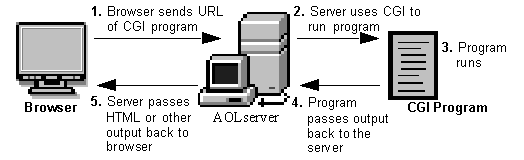
Broadly, the steps are as follows:
A directory is created on the web server containing the CGI scripts/applications. This directory is typically called
CGI-bin.The web application user sends a request to the server via a URL, i.e, https://acme.com/cgi-bin/newchiscript.pl
The server runs the script and passed the resultant output back to the web client
There are some disadvantages to using them: The CGI program starts a new process for each HTTP request which can take up a lot of server memory. A new database connection is opened each time. Data cannot be cached between page loads which reduces efficiency. However, the risks and inefficiencies outweigh the benefits, and CGI has not kept up with the times and has not evolved to work well with modern web applications. It has been superseded by faster and more secure technologies. However, as testers, we will run into web applications from time to time that still use CGI and will often see it when we encounter embedded devices during an assessment.
CGI Attacks
Perhaps the most well-known CGI attack is exploiting the Shellshock (aka, "Bash bug") vulnerability via CGI. The Shellshock vulnerability (CVE-2014-6271) was discovered in 2014, is relatively simple to exploit, and can still be found in the wild (during penetration tests) from time to time. It is a security flaw in the Bash shell (GNU Bash up until version 4.3) that can be used to execute unintentional commands using environment variables. At the time of discovery, it was a 25-year-old bug and a significant threat to companies worldwide.
Shellshock via CGI
The Shellshock vulnerability allows an attacker to exploit old versions of Bash that save environment variables incorrectly. Typically when saving a function as a variable, the shell function will stop where it is defined to end by the creator. Vulnerable versions of Bash will allow an attacker to execute operating system commands that are included after a function stored inside an environment variable. Let's look at a simple example where we define an environment variable and include a malicious command afterward.
When the above variable is assigned, Bash will interpret the y='() { :;};' portion as a function definition for a variable y. The function does nothing but returns an exit code 0, but when it is imported, it will execute the command echo vulnerable-shellshock if the version of Bash is vulnerable. This (or any other command, such as a reverse shell one-liner) will be run in the context of the web server user. Most of the time, this will be a user such as www-data, and we will have access to the system but still need to escalate privileges. Occasionally we will get really lucky and gain access as the root user if the web server is running in an elevated context.
If the system is not vulnerable, only "not vulnerable" will be printed.
This behavior no longer occurs on a patched system, as Bash will not execute code after a function definition is imported. Furthermore, Bash will no longer interpret y=() {...} as a function definition. But rather, function definitions within environment variables must now be prefixed with BASH_FUNC_.
Exploitation - Example
Hunting for CGI:
Once the vulnerability has been confirmed, we can obtain reverse shell access in many ways. In this example, we use a simple Bash one-liner and get a callback on our Netcat listener.
Mitigation
This blog post contains useful tips for mitigating the Shellshock vulnerability. The quickest way to remediate the vulnerability is to update the version of Bash on the affected system. This can be trickier on end-of-life Ubuntu/Debian systems, so a sysadmin may have first to upgrade the package manager. With certain systems (i.e., IoT devices that use CGI), upgrading may not be possible. In these cases, it would be best first to ensure the system is not exposed to the internet and then evaluate if the host can be decommissioned. If it is a critical host and the organization chooses to accept the risk, a temporary workaround could be firewalling off the host on the internal network as best as possible. Keep in mind that this is just putting a bandaid on a large wound, and the best course of action would be upgrading or taking the host offline.
Last updated